Swakirti Sidhu
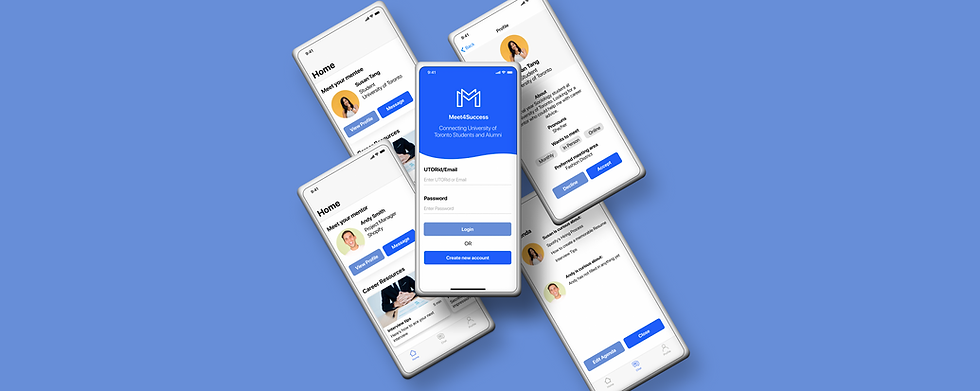
Meet4Success
An application to connect current students and alumni of University of Toronto for 1-on-1 mentorship matching
A partnered project with the
Overview
Project Type:
UX research & design, product design
Tools: Illustrator and Figma
Industry: Education
Methodologies:
IBM Design Thinking Framework, Iterative
My Role:
I did competitive analysis and user research by conducting interviews and surveys, ideated, prototyped design, conducted usability testing and provided data along with storyline for the presentation.
Duration: October 2019 - December 2019
Skills:
Competitive analysis, user research, user interviews, persona creation, empathy mapping, wire framing, storytelling, storyboarding, prototyping and usability testing.
Team Size: 4 members
The Problem
University of Toronto students are unsure where to turn to for career advice and on the other hand alumni of the university wants to help students but need a solution that fits into their busy schedule.
The Solution
A mobile platform that connects University of Toronto students and alumni across faculties so they can have an impactful 1-on-1 mentorship experience.
Design process
How we came to this solution was by following design thinking process of research, ideation, prototyping and evaluation. We went through 2 week cycle for each process and presented each stage in front of design professionals at University of Toronto.

-
Competitive Analysis
-
User research
-
User interviews
-
User surveys
-
Persona
-
Empathy mapping
-
As-is scenario
-
Needs statement

-
Big ideas
-
Prioritization
-
To-be secenario
-
Hills statement

-
Sketch prototype
-
Guerrilla testing
-
A/B testing

Research
We conducted secondary research and further primary research was done by conducting semi structured interview and survey to understand current mentorship program situation at University of Toronto.
Semi structured interviews

8 current students
8 alumni of the university
Survey

18 current students
19 alumni of the university

Sample interview and survey questions
All the participant were recruited at random through campus and through our own professional networks for both interview and survey.
Research Key Findings
1. Networking platform currently used to connect
We found that students and alumni use different networking tools, with students preferring Facebook and alumni preferring LinkedIn. This makes it difficult for students and alumni to connect and neither of these tools are tailored to their interests/needs.

68 % of students
use facebook to connect

78% of alumni use linkedIn to connect
2. Value of Mentorship

Our research data relvealed that both students and alumni felt mentorship is important.
3. Common Needs of both Students and Alumni


Currently a proper resource is not available to connect students and alumni to one another in a way that fits into both of their busy academic and professional lives.
As a result we created two personas Susan the student and Andy the alumni. It was important to have two personas because mentorship is not successful if their is any disconnect between students and alumni.
We mapped their needs, goals and obstacles using empathy mapping. This helped us empathize with our user and look deeply into how our user thinks, feels, does and says.
Susan the Student
Needs and Wants
-
Carrer advice
-
Advice regarding life after graduation
-
Confidence while entering workplace
-
To develop a positive relationship with a mentor
Obstacles
-
Overwhelmed and busy with school
-
Experience anxiety
-
U of T lacks resources to connect with potential mentors.
Susan the Student Proto-persona, Persona, Empathy Map & Need statements


Andy the Alumni
Needs and Wants
-
Find a mentee that he can meaningfully connect with
-
Improve and build leadership skills
-
Give back to the community
Obstacles
-
Busy with work and personal life
-
Efficient communication and scheduling method.
Andy the Alumni Proto-persona, Persona, Empathy Map & Need Statements


Ideation

Big Ideas
Our team came up with some big ideas. These big ideas were formulated keeping in mind our personas Susan's and Andy's needs and requirements. The obstacles they are currently facing were also kept in mind so that we can overcome those obstacles as well.
I contributed to 6 out of 22 ideas.
Prioritization Grid

We narrowed down our big ideas by voting to the most feasible (ideas that can be implemented) and most impactful (ideas that will have the maximum affect) ideas. Red dot indicates impactful and green dot indicates feasible ideas.
These big ideas helped us visualize a new happy path to-be scenario for Susan and Andy which solved few needs and requirement for them. With new vision our team came up with 3 Design Statement which reflects how the big ideas would impact their life now
1. Susan and Andy both can have meaningful relationship through customized matching.
2. Susan and Andy can have convenient and professional communication platform within minutes of signing in.
3. Susan and Andy are able to understand each other's needs and goals within minutes of signing In
Prototype
Low Fidelity Prototypes
Our team initially sketched low fidelity sketches and performed guerrilla usability testing using think a loud protocol and A/B testing with those sketches. We recruited 4 graduate students while performing these testings.

Guerrilla usability testing using think aloud protocol

Our group completed A/B testing with representative users (4 U of T grad students) on sign in options:
Option A: Sign-in using UTORid and add an email to your account to sign in in the future
Option B: Use UTORid to sign in and make email optional
Participants found option A redundant and confusing, so we changed the process to sign in with a UTORid only which was option B
User Flow
From initial user feedback and brainstorming session of our team we came up with a user flow which includes signing up, setting up profile, getting matched, starting conversation, requesting meeting, plan meeting, gets a reminder regarding meeting, feedback after the meeting and Susan is also reminded to send thank you message to Andy
Our solution solved our user needs as following -
1. One on one matching makes our user more accountable and less over whelembed
2. The application is solely for mentorship and this is also not siloed within faculty as a result connects students and alumni across faculties
3. Setting up agenda gives clear picture to both alumni and students regarding goals of the meeting.
4. No personal phone number shared which benefits alumni and students by not overloading their work or personal inboxes with messages.


Iteration
We incorporated our users suggestions and industry professional feedback from our presentation and made some changes to our design.

Issue 1:
We received feedback from our users and industry professionals that P for plan meeting was confusing.
Heuristic Violated:
Match between system and the real world
Iteration:
In our next iteration we added a button Create Agenda so that it describes the function to users properly


Issue 2:
We received another feedback from our users during our low-fi paper testing that the feedback page should be after thank you message and they should be given an options to opt-out of it as well.
Heuristic Violated:
User Control and freedom
Iteration:
Therefore in Mid-fi prototype we moved the feedback page after the thank you message and user’s like Susan can totally choose if they want to give feedback or not.
Play the video to see the changes made to the design for issue 2
Medium Fidelity Prototype
We designed our medium fidelity prototype in Figma.
Customized matching
Students and alumni are matched according to the preferences they choose while setting up the account

Susan the students setting up her account and getting matched with Andy.

Andy the alumni setting up his account and getting matched with Susan.
Let the conversation flow and set up agenda for clear goals

Message prompt option is added to reduce anxiety among students and they can even add meeting details to their calendars.

Students like Susan can set clear agenda for a structured meeting.
Evaluation
We further evaluated our design by conducting usability testing with 4 users which included 2 current students and 2 alumni. Once usability testing was finished we conducted a semi-structured interview with our users. I contributed by conducting usability testing and later in depth interview with one student and one alumni.
All our users expressed how they loved the custom matching and the message prompt feature reduced anxiety while messaging for the first time. They also loved setting up an agenda feature because that would help keep the meeting goals clear. Although feedback page did not make that much sense to our users.
Next Steps
As our next steps we would conduct more usability testing and iterate so that our product is aligned with our user needs and requirements. We would also like to add additional features in further updates (i.e. advertising, networking events, career resources) so that we can increase our user engagement.
Key Learnings
1. We are designing for our users - Research is a very major part as our product is designed for our users. It is very important to have as many in depth interviews and testings as possible so that we can resolve maximum pain points of our user's.
2. Iteration is very essential - It is very essential to iterate our process. To get a user friendly output it is very important to keep our stakeholders in the loop.
Design Team

From Left to right - Anna Yu, Sonal Pala, Swakirti Sidhu (me), Stacey Morton